My Morning Routine

It all begins with an idea. Maybe you want to launch a business. Maybe you want to turn a hobby into something more. Or maybe you have a creative project to share with the world. Whatever it is, the way you tell your story online can make all the difference.

Don’t worry about sounding professional. Sound like you. There are over 1.5 billion websites out there, but your story is what’s going to separate this one from the rest. If you read the words back and don’t hear your own voice in your head, that’s a good sign you still have more work to do.

Be clear, be confident and don’t overthink it. The beauty of your story is that it’s going to continue to evolve and your site can evolve with it. Your goal should be to make it feel right for right now. Later will take care of itself. It always does.

Maecenas sed diam eget risus varius blandit sit amet non magna. Vestibulum id ligula porta felis euismod semper. Duis mollis, est non commodo luctus, nisi erat porttitor ligula, eget lacinia odio sem nec elit. Aenean eu leo quam. Pellentesque ornare sem lacinia quam venenatis vestibulum. Sed posuere consectetur est at lobortis. Morbi leo risus, porta ac consectetur ac, vestibulum at eros. Cum sociis natoque penatibus et magnis dis parturient montes, nascetur ridiculus mus.

Donec id elit non mi porta gravida at eget metus. Nullam quis risus eget urna mollis ornare vel eu leo. Sed posuere consectetur est at lobortis. Maecenas sed diam eget risus varius blandit sit amet non magna. Nulla vitae elit libero, a pharetra augue. Etiam porta sem malesuada magna mollis euismod.

Lorem ipsum dolor sit amet, consectetur adipiscing elit. Donec ullamcorper nulla non metus auctor fringilla. Donec id elit non mi porta gravida at eget metus. Duis mollis, est non commodo luctus, nisi erat porttitor ligula, eget lacinia odio sem nec elit. Etiam porta sem malesuada magna mollis euismod. Praesent commodo cursus magna, vel scelerisque nisl consectetur et.

Fusce dapibus, tellus ac cursus commodo, tortor mauris condimentum nibh, ut fermentum massa justo sit amet risus. Vestibulum id ligula porta felis euismod semper. Aenean eu leo quam. Pellentesque ornare sem lacinia quam venenatis vestibulum. Maecenas faucibus mollis interdum. Cras mattis consectetur purus sit amet fermentum.
Productive Habits

It all begins with an idea. Maybe you want to launch a business. Maybe you want to turn a hobby into something more. Or maybe you have a creative project to share with the world. Whatever it is, the way you tell your story online can make all the difference.

Don’t worry about sounding professional. Sound like you. There are over 1.5 billion websites out there, but your story is what’s going to separate this one from the rest. If you read the words back and don’t hear your own voice in your head, that’s a good sign you still have more work to do.

Be clear, be confident and don’t overthink it. The beauty of your story is that it’s going to continue to evolve and your site can evolve with it. Your goal should be to make it feel right for right now. Later will take care of itself. It always does.

Integer posuere erat a ante venenatis dapibus posuere velit aliquet. Donec id elit non mi porta gravida at eget metus. Praesent commodo cursus magna, vel scelerisque nisl consectetur et. Praesent commodo cursus magna, vel scelerisque nisl consectetur et. Sed posuere consectetur est at lobortis. Nulla vitae elit libero, a pharetra augue. Praesent commodo cursus magna, vel scelerisque nisl consectetur et.

Donec sed odio dui. Etiam porta sem malesuada magna mollis euismod. Vivamus sagittis lacus vel augue laoreet rutrum faucibus dolor auctor. Nulla vitae elit libero, a pharetra augue. Morbi leo risus, porta ac consectetur ac, vestibulum at eros.

Donec id elit non mi porta gravida at eget metus. Morbi leo risus, porta ac consectetur ac, vestibulum at eros. Integer posuere erat a ante venenatis dapibus posuere velit aliquet. Donec sed odio dui. Donec sed odio dui.

Maecenas faucibus mollis interdum. Donec ullamcorper nulla non metus auctor fringilla. Cras mattis consectetur purus sit amet fermentum. Maecenas faucibus mollis interdum. Nullam quis risus eget urna mollis ornare vel eu leo. Nullam id dolor id nibh ultricies vehicula ut id elit.
Top 10 Places to Visit

It all begins with an idea. Maybe you want to launch a business. Maybe you want to turn a hobby into something more. Or maybe you have a creative project to share with the world. Whatever it is, the way you tell your story online can make all the difference.

Don’t worry about sounding professional. Sound like you. There are over 1.5 billion websites out there, but your story is what’s going to separate this one from the rest. If you read the words back and don’t hear your own voice in your head, that’s a good sign you still have more work to do.

Be clear, be confident and don’t overthink it. The beauty of your story is that it’s going to continue to evolve and your site can evolve with it. Your goal should be to make it feel right for right now. Later will take care of itself. It always does.

Praesent commodo cursus magna, vel scelerisque nisl consectetur et. Cum sociis natoque penatibus et magnis dis parturient montes, nascetur ridiculus mus. Nulla vitae elit libero, a pharetra augue. Etiam porta sem malesuada magna mollis euismod. Nullam id dolor id nibh ultricies vehicula ut id elit.

Duis mollis, est non commodo luctus, nisi erat porttitor ligula, eget lacinia odio sem nec elit. Curabitur blandit tempus porttitor. Aenean eu leo quam. Pellentesque ornare sem lacinia quam venenatis vestibulum. Fusce dapibus, tellus ac cursus commodo, tortor mauris condimentum nibh, ut fermentum massa justo sit amet risus. Donec sed odio dui.

Aenean lacinia bibendum nulla sed consectetur. Curabitur blandit tempus porttitor. Donec id elit non mi porta gravida at eget metus. Praesent commodo cursus magna, vel scelerisque nisl consectetur et. Nullam quis risus eget urna mollis ornare vel eu leo. Vivamus sagittis lacus vel augue laoreet rutrum faucibus dolor auctor.

NJEDGE Presentation, November 18-20, 2015

In this presentation, we focus on defining informal learning spaces, outlining how we developed and implemented the virtual learning environment (VLE), and addressing ways to integrate tools and practices to build the informal learning space in the virtual environment.

What is the role of higher education in a digitally rich landscape? Digital and networked technologies have challenged the traditional university framework. Increasingly, we are embracing new designs for virtual learning spaces in a highly-connected age, an age in which the hierarchies and gatekeepers of the old world have been flattened. While visual analysis has informed educational theory and design, there remains a need to understand the interface of the digital and the pedagogical (Bayne, 2008).

In this digitally rich landscape, Stevens has made great steps to embark on new forms of scholarship in virtual learning spaces, hybrid course design, and learning analytics. The VLE (Virtual Learning Environment) was designed to help Stevens move to a BYOD (Bring your Own Device) environment allowing students to access the newest versions of their programs anytime and anywhere, which will prevent redundancy in managing the learning space. The VLE should also promote lifelong learning by providing a dedicated space for students to save coursework and projects. However, little has been done to design the informal learning space for a virtual environment.

Formal learning as defined by the OECD (2014) as always ‘organized and structured, and has learning objectives. From the learners’ standpoint, it is always intentional.” This type of learning tends to be built around ‘persistent technologies which foreground text-based communication’ (Philips, 2006). Whereas, informal learning are those events that occur outside the “classroom.” Another term for this type of learning is experiential learning, or “learning through reflection on doing” (Felicia, 2011).

Through our research, we seek to define the informal learning space and to answer questions such as: how do you design the informal space online? Where does learning happen? How do we design experiential learning? What are the values of an informal learning space?

This project would not have been possible without the work of our mobile computing technologist, Frank Filogamo, and Design Educator and Director, John Nastasi. We also rely on a faculty review team to assess tools for virtual informal learning. This research is still in an exploratory phase. We will have our data by early fall.​

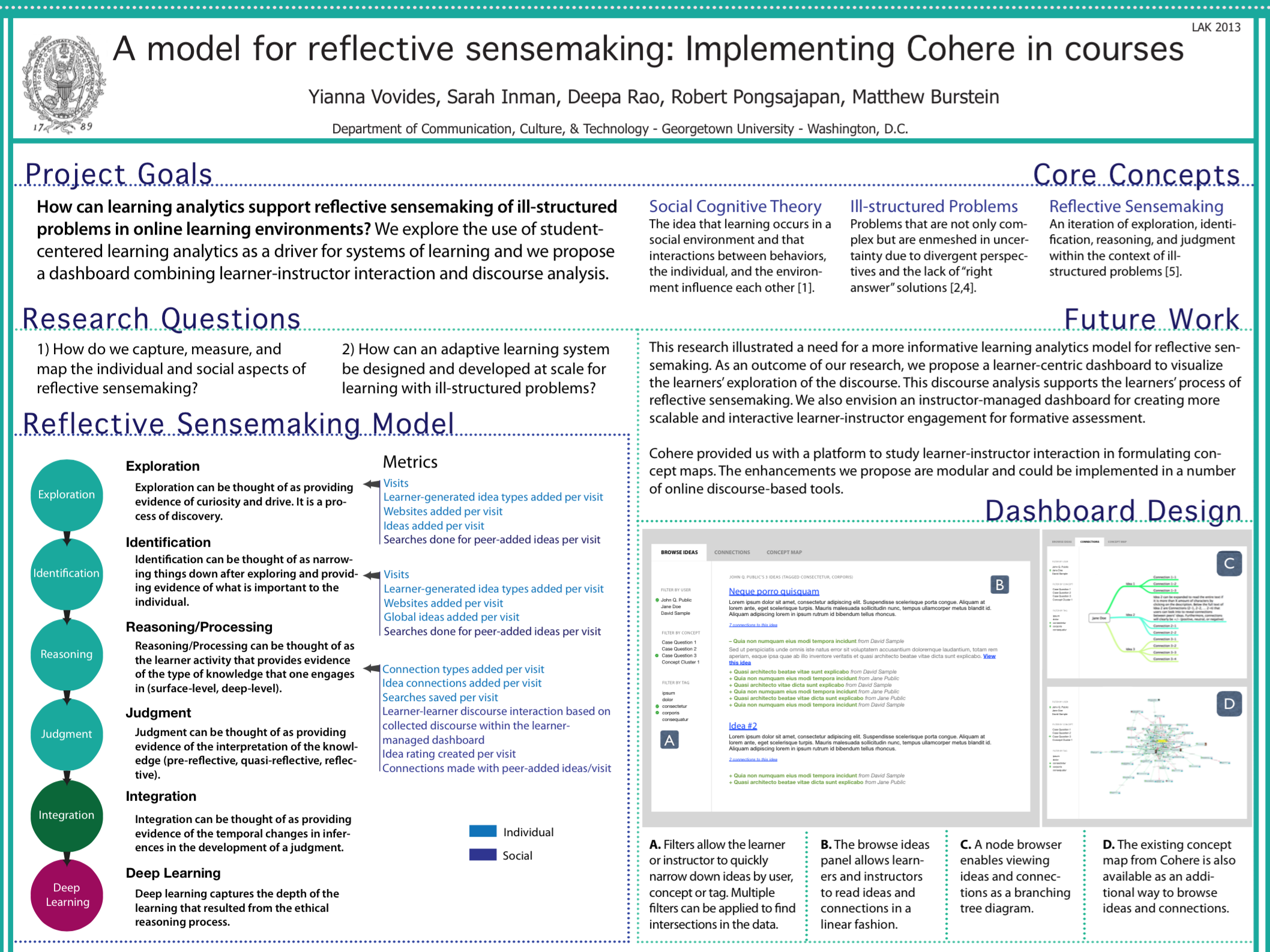
Enabling Meaningful Certificates from Massive Open Online Courses (MOOCs): A Data-Driven Curriculum E-Map Design Model -Yianna Vovides & Sarah Inman

Published in forthcoming book, Open Learning and Formal Credentialing in Higher Education: Curriculum Models and Institutional Policies

This book Open Learning and Formal Credentialing in Higher Education: Curriculum Models and Institutional Policies [Keppell, Reushle & Antonio] published by IGI Global, will explore the philosophy, politics, theories, debates, curriculum models and assessment practices associated with the development of formal credentials in response to open and lifelong learning. The growth of access to “learning anywhere anytime” enabled through open education practices and open education resources (OERs), has led to increasing pressure for Higher Education institutions to develop relationships between a learner’s lifelong and personalized learning; and formal qualifications. The book will document advances and innovations in the design, implementation and integration of curriculum models that include recognition practices and credentials for open and lifelong learning. These advances include, but are not exclusive to, the emergence of digital badges and backpacks; credit pathways for MOOCS; learning pathways for lifelong learning; innovative recognition pedagogies that formalise open education practices, assessment practices responsive to prior informal learning, and ePortfolios used for credentialing purposes.

On Owning Nature: Part II

(And the Pleasure of Life)

 Beneath the fog, I miss the hot breath
Of lovers’ abated anticipation
Forgive me, death
I have not forsaken you.
Take caution in your felicitations
For we have not proved our innocence yet

I had intentions of telling you about European trepidation—of French elites clinking glasses of rosé in the Aix-en-Provence countryside. White linens and fresh cheese from the farm.  What a tempting romance—to sing the praises of uniqueness!  Of a fear of globalization and the perversities of strangers it may introduce.  But instead, I want to tell you a cautionary tale.

To speak of prudence in an era of unprecedented technological ‘progress’ is almost blasphemous.  However, there has been growing public dissent in the EU toward genetically modified organisms[1].  Roger Cohen of the New York Times writes that, “the specter of nature being rendered more uniform by scientists in America has meshed with a wider fear of an increasingly undifferentiated planet where national distinctions fade.”  The European approach to implementing technological innovations is characterized by precautionary sentiments where we, here in the United States, have tended to allow innovations to seize the market barring direct scientific evidence of harm. Though this may be in line with the view of individualistic freedom, it places the burden of proof upon the victim of dominating infiltrators; this is characterized in a multiplicitous array of ways from the use of hormones in beef to the ‘drill baby drill’ attitude toward hydraulic fracturing to the proliferation of genetically modified seeds and so on.

It is often in my constitution to run quickly into the sea without surveying to see how deep it is.  But I am willing to concede that in my maturation I have developed a reverence for caution, for anticipation.

The major difference in the approaches across the pond lies in this issue of caution – particularly with regard to risk assessment.  For the EU, in the absence of relevant scientific evidence, one can invoke the precautionary principle.  The precautionary principle does not explicitly require scientific consensus to take action against a policy that is suspected to be risky.  Rather, those implementing the policy or taking the action are encumbered with the burden of proof to show that the action is notharmful.  Paragraph 2, Article 191 of the Lisbon Treaty states: “union policy on the environment shall aim at a high level of protection taking into account the diversity of situations in the various regions of the Union.  It shall be based on the precautionary principle and on the principles that preventive action should be taken, that environmental damage should as a priority be rectified at source and that the polluter should pay.” This is something that makes the EU resistant to allowing GMOs into the market.

Lynch & Vogel point out that “when Europeans think of wildlife and the rural environment, they think of farmland, and for them GM technology appears to be the next step in an unwelcome intensification of agriculture.  Americans, in contrast, think of the wilderness areas their national parks; they regard farmland as part of the industrial systems” (17).  Herein lies a fundamental issue of individual rights versus communitarian values, and a key difference in the U.S. and EU views on genetically modified organisms.  The political pundits and industry leaders have tried to propose that both genetically modified seeds and organic seeds can flourish in harmony relying on the mantra of individual rights.  However, the reality is that the harmful impacts of the modified seeds and their proliferation have shown that we do not live in isolation.

So perhaps I should have titled this ‘Ode to Precaution’.  A thank you note to an under-appreciated and somewhat bullied perspective. It is not sexy; it is not Hollywood; it is a cap over the electrical socket; it is slowing down at a yellow light; it is turning off the radiator when you leave the house.


[1] ”GMO” stands for Genetically Modified Organism–this is an organism that has been genetically engineered.  These are used in a number of fields spanning from pharmaceuticals to research to agriculture.  In my previous post, I wrote about the patent protections of genetically modified seeds.

Photograph by Kevin Dooley

Lynch, D. and Vogel, D. (2001). The regulation of GMOs in Europe and the United States: A case-study of contemporary European regulatory politics. Council on Foreign Relations. 1-39.

Posted under: BlogTechnology & Society